
 Search


 English
 Français
 русский
 Español
News

What Is Boucle Yarn and How Is It Used in Knitwear?
 2026.03.01
 Industry News
Boucle yarn is one of the most recognized and commercially significant fancy yarn types in the global textile industry. From the iconic woven tweed jackets of luxury fashion houses to premium knitwear collections, premium home textiles, and high-end upholstery, boucle's looped, textured surface is synonymous with quality, craftsmanship, and fashion authority. For brand designers, knitwear manufacturers, fabric mills, and yarn buyers, understanding what boucle yarn is, how it is constructed, what its different types offer, and what specifications to look for when sourcing is fundamental to working with this category effectively.
This guide covers the full technical and commercial picture of boucle yarn — from the mechanics of how the loops are formed during production, through the range of fiber compositions available (from ordinary boucle to high-grade wool and cashmere boucle), to how to evaluate boucle yarn quality and match yarn specifications to your product application.
What Is Boucle Yarn?
Boucle (from the French word meaning "buckle" or "curl") is a fancy yarn characterized by a looped, curled, or knotted surface texture formed during the spinning process. Unlike a plain yarn, where all component fibers are twisted together into a uniform, smooth structure, boucle yarn is deliberately engineered to produce protruding loops along its length — loops that stand away from the yarn's core axis and create the characteristic bumpy, textured surface that makes boucle immediately identifiable in a knitted or woven fabric.
The loops in boucle yarn are not a defect or an accident of spinning — they are a precision-engineered structural feature produced by controlling the differential feed rates and tension of multiple yarn components during the twisting process. The technical mastery required to produce uniform, stable, consistently sized loops at scale is one of the defining marks of an experienced fancy yarn manufacturer.
How Boucle Yarn Is Made: The Three-Component Structure
A properly constructed boucle yarn consists of three distinct component yarns, each playing a specific structural role:
The Core (Effect Yarn / Loop Yarn)
The central component that carries and stabilizes the yarn structure. The core is typically a relatively strong, lightly twisted base yarn — often a worsted wool, wool-blend, or synthetic yarn — that provides the boucle's overall tensile strength and serves as the axis around which the loops are formed. In high-grade boucle yarns, the core may be fine merino wool, cashmere, or a premium wool-silk blend, contributing to the overall fineness and handle of the finished yarn.
The Effect Yarn (Loop-Forming Component)
The component that creates the visible loops. The effect yarn is fed at a faster rate than the core during twisting — this excess feed rate (called "overfeed") causes the effect yarn to buckle and form loops around the core rather than lying flat alongside it. The loop size, density, and regularity are controlled by the ratio of the effect yarn overfeed to the core yarn feed speed. The effect of the yarn's fiber content and count largely determines the visual appearance and hand feel of the boucle — a cashmere or fine merino effect yarn produces a soft, lustrous loop; a mohair effect yarn produces a lighter, slightly fuzzy loop; a wool-silk effect yarn produces a loop with natural luster and drape.
The Binder (Tie Yarn / Fixing Yarn)
A fine, typically high-tenacity yarn — often nylon filament, a fine polyester, or a fine worsted yarn — that is twisted around the core and effect yarn in the opposite direction (counter-twist) to lock the loops in position and prevent them from sliding or unraveling during the boucle's subsequent use in knitting, weaving, or finishing. Without the binder, the loops would not remain stable through the mechanical stresses of industrial knitting or weaving machines. The binder yarn, though usually invisible in the finished fabric, is a critical technical component — a poorly chosen or incorrectly tensioned binder is a common cause of loop instability and fabric quality failures in boucle products.
Types of Boucle Yarn: From Ordinary to High-Grade
Ordinary Boucle Yarn
Ordinary boucle yarn uses standard fiber compositions — typically acrylic, polyester, wool-acrylic blends, or wool-polyester blends — in the core and effect yarn, with a standard nylon or polyester binder. Ordinary boucle delivers the characteristic looped surface texture at accessible price points and is widely used in mass-market knitwear, costume jewelry applications, decorative home textiles (cushion covers, throws), and fashion accessories. Loop sizes in ordinary boucle can range from tight, small loops (producing a dense, textured surface) to larger, more open loops (producing a more dramatic textural effect). Color options are broad — ordinary boucle is commonly produced in both yarn-dyed single colors and space-dyed or twist-blend color effects.
High-Grade Wool Boucle Yarn
High-grade wool boucle uses premium natural fiber content in the effect yarn and often in the core: superfine merino wool (typically 17.5–19.5 micron), cashmere, alpaca, mohair, or combinations of these fibers. The result is a boucle yarn that combines the distinctive looped surface texture with the superior softness, warmth, drape, and natural fiber luster that premium natural fibers deliver. High-grade wool boucle is the material of choice for luxury knitwear brands, couture fabric collections, premium knitwear designers, and high-end home textile manufacturers.
Cashmere boucle — using fine cashmere fiber in the effect yarn — produces a loop that is exceptionally soft to the touch and has a natural, subtle luster. Garments knitted or woven with cashmere boucle have a surface that is simultaneously textured and incredibly soft against the skin, making it a premium specification for luxury sweaters, high-end knitwear cardigans, and fine outerwear. Merino wool boucle, using superfine merino (under 18.5 micron), produces a boucle that is next-to-skin soft (meeting the international itch-free threshold of under 30 micron individual fiber diameter in the finished structure) while delivering the warmth and natural moisture management of merino wool.
Loop Size Variants: Small Loop, Medium Loop, and Large Loop Boucle
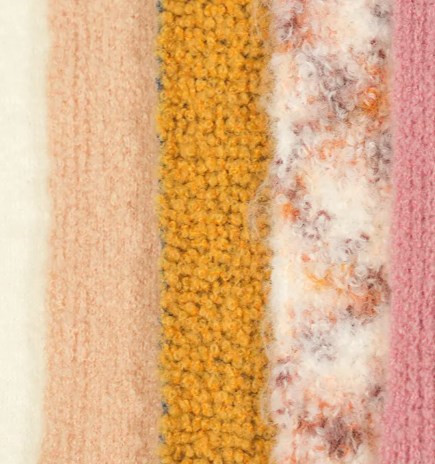
Loop size is one of the most important design variables in boucle yarn specification. It is controlled by the overfeed ratio of the effect yarn during twisting and can be specified when ordering custom boucle from a manufacturer. Small-loop boucle (tight boucle) produces a fabric surface that reads as densely textured with a fine, regular surface pattern — closer to a bouclette or seed-stitch appearance. Medium-loop boucle produces the classic boucle surface most familiar in fashion fabrics. Large-loop boucle produces a dramatic, sculptural surface with pronounced loop protrusions — used for statement knitwear, furnishing fabrics, and fashion-forward outerwear.
Key Performance Properties of Boucle Yarn in Fabric
Surface Texture and Aesthetic Appeal
The looped surface of boucle yarn creates an inherent three-dimensional texture in knitted or woven fabric that cannot be replicated by surface finishing or printing on a plain yarn. Each loop catches light differently from its neighbors, producing the subtle visual depth and complexity that makes boucle fabrics appear richer and more substantial than plain-knit or plain-weave alternatives at the same fiber quality level. This visual complexity — reading as expensive and high-quality to consumers — makes boucle a favored specification for positioning products in the premium and luxury segments of the market.
Thermal Insulation
The loops in boucle yarn trap air within the fabric structure, providing a higher level of thermal insulation per unit weight than a comparable plain yarn fabric of the same fiber content. This makes boucle particularly well-suited for autumn/winter knitwear, outerwear, and layering garments where warmth-to-weight ratio is a commercial specification.
Tactile Softness (in High-Grade Constructions)
In high-grade wool or cashmere boucle, the effect yarn loops that contact the skin are composed of the softest available natural fibers. Because the loops protrude away from the yarn core, the skin touches the effect yarn loops rather than the core or binder, meaning the tactile experience of a cashmere or fine merino boucle garment is primarily that of the premium loop fiber. This makes high-grade boucle an excellent specification for garments intended to be worn without a liner against sensitive skin.
Dimensional Stability Considerations
Boucle fabrics require careful attention to dimensional stability in finishing and care, because the loops can be prone to snagging, loop distortion, or loop relaxation if the binder yarn tension is insufficient or if aggressive mechanical finishing is applied. Professional boucle yarn manufacturers specify binder yarn content and tension to ensure loop stability through industrial and domestic laundering. When evaluating boucle yarn from a supplier, request wash stability test data — specifically loop stability and dimensional change after repeated wash cycles per ISO 6330 or the equivalent standard relevant to your target market.
Boucle Yarn Applications by Product Category
| Application | Recommended Boucle Type | Loop Size | Key Specification |
|---|---|---|---|
| Luxury knitwear/sweaters | High-grade cashmere or superfine merino boucle | Small to medium | Fiber micron under 18.5μm; loop stability after 5 wash cycles; OEKO-TEX certified |
| Premium fashion outerwear (woven) | High-grade wool boucle or wool-mohair boucle | Medium to large | Loop density consistency; warp/weft integration stability; colorfastness ISO 105 |
| Mid-market knitwear | Ordinary wool-acrylic or wool-polyester boucle | Medium | Pilling resistance (ISO 12945-2); loop uniformity; price efficiency |
| Home textiles (throws, cushion covers) | Ordinary acrylic or polyester-wool boucle | Medium to large | Colorfastness, loop snag resistance, and wash durability |
| Statement fashion knitwear (designer) | High-grade alpaca, mohair, or cashmere boucle in contrast colors | Large | Loop regularity; fiber luster; custom color matching |
| Accessories (scarves, hats) | Ordinary or high-grade boucle, color variants | Small to medium | Hand softness; loop stability; weight per meter |
How to Evaluate Boucle Yarn Quality When Sourcing
Loop uniformity. High-quality boucle yarn has consistent loop size and spacing along its entire length. Irregular loop size — some loops are very large, others are collapsed — indicates inconsistent overfeed tension during production. Request a 5-meter length yarn sample and examine loop consistency under normal light before approving for production.
Binder security. Gently pull a loop away from the yarn body and release it. In a well-constructed boucle, the loop returns to its original position without the binder unwrapping. If the binder unravels or the loop slides along the core under light tension, the binder yarn specification or tension is insufficient for the mechanical stresses of industrial knitting or weaving.
Fiber content verification. For high-grade wool or cashmere boucle, request fiber content test certificates (IWTO or equivalent) confirming the cashmere or merino wool content and micron count. The distinction between genuine cashmere boucle and "cashmere-style" (cashmere-blended or cashmere-like) boucle is commercially significant, and the fiber content test certificate is the standard means of verification.
Pilling resistance. Boucle's looped surface makes it inherently more prone to pilling than plain yarn fabrics of the same fiber content, because the loops have more free fiber ends exposed at the surface. High-grade boucle yarns are engineered (through fiber selection, twist parameters, and binder construction) to minimize pilling while maintaining the soft, open loop structure. Request pilling resistance test data per ISO 12945-2 (Martindale method) on a knitted swatch before approving yarn for knitwear production.
Frequently Asked Questions
Is boucle yarn only used for knitting?
No — boucle yarn is used in both knitted and woven constructions. Knitted boucle fabrics (sweaters, cardigans, knitwear accessories) are the most widely known application, but boucle yarn is also woven into coat fabrics, upholstery fabrics, and fashion suiting fabrics. In woven applications, boucle is typically used as the weft yarn, with a plain or worsted yarn in the warp. The boucle loops appear on the fabric face and create a textured, dimensional surface in the finished woven fabric — the aesthetic associated with classic fashion tweed and bouclé jacket fabrics.
What is the difference between ordinary boucle and high-grade wool boucle?
The difference lies primarily in the fiber content of the effect yarn (the loop-forming component). Ordinary boucle uses acrylic, polyester, or standard wool-synthetic blends in the effect yarn, producing a fabric that has the boucle's characteristic texture at accessible price points. High-grade wool boucle uses premium natural fibers — cashmere, superfine merino, alpaca, mohair, or combinations — in the effect yarn, producing a boucle that combines the textured surface with the softness, warmth, natural drape, and luxury positioning of premium natural fiber. The price difference between ordinary and high-grade boucle reflects the significant cost premium of cashmere and superfine merino fiber relative to synthetic alternatives.
Can boucle yarn be machine-washed?
Wash care for boucle yarn products depends on the fiber content. Ordinary boucle with synthetic fiber content is typically machine washable at 30–40°C on a delicate cycle. High-grade wool and cashmere boucle requires gentle or hand-wash care — wool fiber is susceptible to felting under agitation in hot water, and the boucle's loop structure can be distorted by aggressive mechanical washing. Always refer to the yarn manufacturer's wash care data for the specific fiber content and construction. Garments knitted or woven in high-grade cashmere or merino boucle should be labeled with care instructions that match the yarn's confirmed wash test data.
Boucle Yarn from Jiangsu Haoye Fiber Technology
Jiangsu Haoye Fiber Technology Co., Ltd., Jiangyin, Jiangsu, produces both Fancy Boucle Yarn (ordinary) and High-Grade Boucle Yarn (premium natural fiber) across a range of fiber compositions, loop sizes, and color options. With 21 years of specialty yarn experience, 5 sets of dedicated fancy yarn equipment, and OEKO-TEX certified production, Haoye's boucle yarns are supplied to knitwear manufacturers, fashion fabric mills, and home textile brands globally. Custom specifications available — loop size, fiber content (cashmere, superfine merino, alpaca, mohair, silk blends), yarn count, and custom color matching to Pantone or physical sample reference. Raw yarn and color yarn with color cards in stock for fast-response orders.
Contact us to request boucle yarn samples, fiber content test certificates, and custom specification quotations.
Related Products: Fancy Boucle Yarn | High-Grade Boucle Yarn | High-Grade Wool Fancy Yarn | Ordinary Fancy Yarn | Cashmere Yarn



Contact Us for more details
Quick Links
Products
Contact Information
Address: No.2 Huangtai Rd, Yunting, Jiangyin, Jiangsu, China
Tel: +86-510-86018587
Mobile: +86-18261518580
Email: [email protected]
